
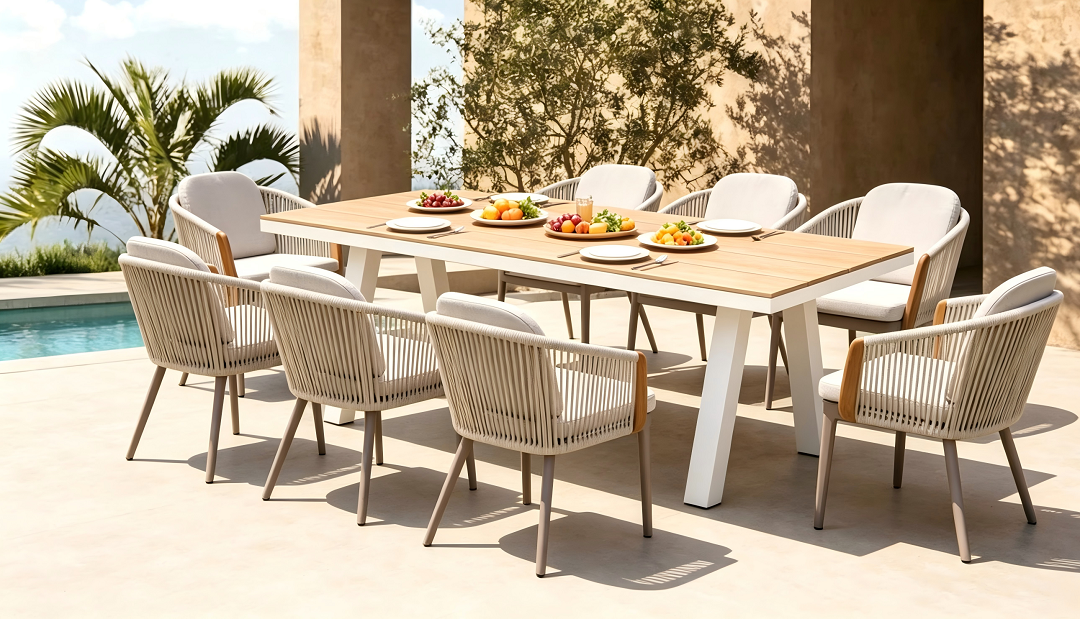
Selecting garden furniture of appropriate size requires three steps: accurately measure your outdoor space (including obstacles and access routes), apply standard clearance rules (24–30 inches walkway clearance, 100cm around dining tables), and match furniture footprint to the available area. For wholesale buyers, size accuracy directly impacts return rates, container utilization, and end-customer satisfaction. This guide covers the measurement framework, standard dimension references, and sourcing considerations that help garden furniture wholesalers make confident purchasing decisions.
Why Getting the Size Right Matters More Than You Think
For garden furniture wholesalers, size accuracy is not merely a design preference — it is a commercial decision. End customers who purchase oversized sets for compact patios generate returns, complaints, and negative reviews that damage your brand reputation downstream. Overly small furniture in spacious gardens creates a perception of poor value, reducing repeat purchase rates and retail partner confidence.
The global shift toward smaller urban outdoor spaces has made this challenge even more acute. Compact balconies, rooftop terraces, and courtyard gardens now represent a growing share of the residential market in Europe, North America, and Australia. Meanwhile, hospitality buyers — hotels, restaurants, and resorts — demand furniture that maximises seating capacity without compromising guest circulation. Accurate sizing intelligence at the sourcing stage prevents costly mismatches across both segments.
How To Measure Your Outdoor Space: A Step-by-Step Framework
What Tools and Preparation Do You Need Before Measuring?
Before selecting any garden furniture, conduct a thorough site survey. You will need a measuring tape (at least 5 metres), masking tape or chalk for marking layouts, and a notepad or digital floor planner. If you are measuring on behalf of a wholesale client, request photographs and a rough sketch of the space, including door widths and any architectural constraints.
Measure the full length and width of the patio, decking area, or balcony, then note anything that cannot be moved — planters, built-in seating, railings, steps, or permanent shade structures. For balconies, measure height limitations from the floor to any overhead obstruction such as a balcony rail or overhanging branch. These constraints determine the maximum height of dining tables, parasols, and vertical planters.
How Do You Account for Movement and Clearance?
Raw floor area is only the starting point. Furniture requires breathing room. The widely accepted rule is to leave at least 24–30 inches (61–76 cm) of walkway clearance around every furniture grouping so people can move freely without brushing against chairs or table edges. For dining areas, allow approximately 100 cm from the table edge to the nearest wall or boundary — this enables diners to pull out chairs and sit down comfortably.
In commercial settings such as restaurant terraces or hotel pool decks, increase clearance to 36 inches (91 cm) to accommodate service staff movement, trolley access, and emergency egress requirements.
Why Marking the Footprint Before Buying Saves Money
A furniture set’s listed dimensions rarely capture the full floor space required in use. A dining table measuring 160cm × 90cm, for example, demands additional depth for chairs pushed back — typically another 75–100cm on each side. Professional buyers should always request the product footprint, an overhead outline showing the minimum floorspace required for the complete set in use.
Use masking tape or chalk to mark the footprint on site before committing to an order. This low-cost exercise prevents the most expensive mistake in garden furniture procurement: buying a set that technically fits the room but leaves no space to actually use it.
Standard Garden Furniture Dimensions: A Reference for Wholesale Buyers
What Are the Standard Dimensions for Outdoor Dining Tables?
Rectangular outdoor dining tables for four people typically measure 48–60 inches (122–152 cm) in length and 28–30 inches (71–76 cm) in height. Tables measuring 6–8 feet accommodate 6–8 chairs. As a general rule, each diner requires at least 60 cm of tabletop width to eat comfortably, and round tables need a diameter of at least 100 cm for four people.
For wholesale buyers, these standard dimensions represent the highest-volume SKUs in most markets. Deviating significantly from these norms risks inventory that sits unsold because it does not align with end-customer expectations formed by years of exposure to standard sizing.
What Seat Heights and Widths Should You Stock?
Standard outdoor dining chairs have seat widths of 45–55 cm, seat depths of 40–48 cm, and seat heights of 43–50 cm from the ground. Lounge chairs and sectionals are bulkier: a standard lounge chair measures 25–30 inches (64–76 cm) wide and 35–40 inches (89–102 cm) deep.
For commercial-grade garden furniture, CDG Furniture manufactures seating with reinforced aluminium frames that maintain dimensional integrity under intensive daily use. Seat dimensions can be customised within ±5% of standard specifications to suit specific market preferences — for example, broader seats for North American buyers and more compact profiles for European urban balconies.
How Should You Plan Sofa and Lounge Set Footprints?
A four-seater rattan bistro or dining set typically occupies a footprint of roughly 130cm before any chair movement is considered. For lounge configurations, a mid-size deck in the 10–16 foot range suits a 4–6 piece conversation set with a loveseat, two chairs, and a coffee table, while larger backyards can support distinct zones for dining and lounging.
When sourcing sofa sets for wholesale distribution, request the packed volume per set alongside the assembled footprint. Container loading efficiency depends on both dimensions — a set that assembles to 2.5m × 2m but packs into 1.2 CBM per unit offers significantly better logistics economics than one packing at 1.8 CBM.
Size Selection by Space Type and Customer Segment
Compact Spaces: Balconies and Courtyards Under 8 × 10 Feet
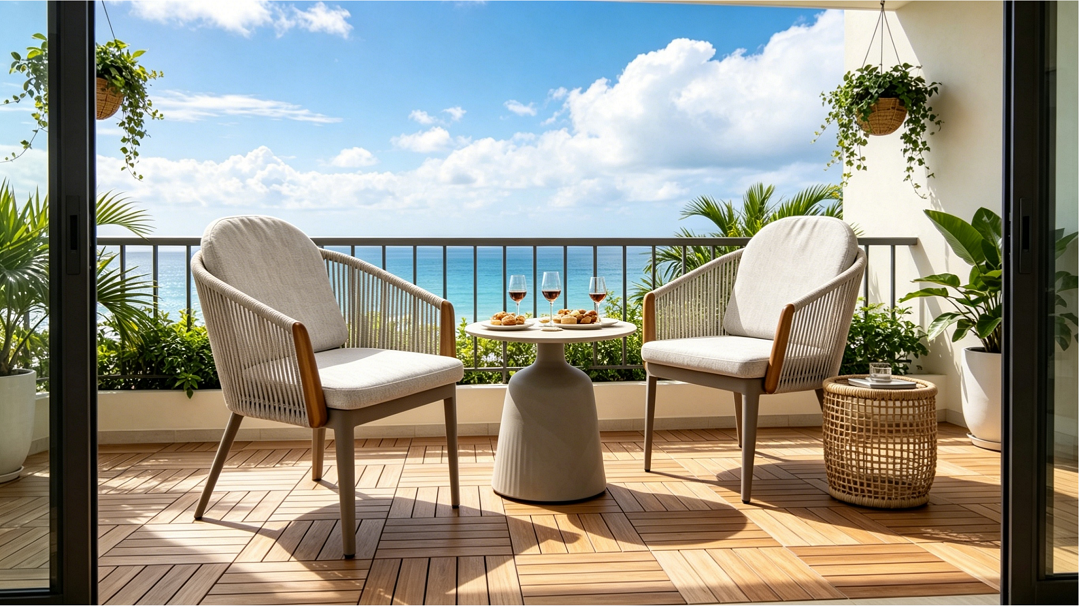
For small patios and balconies, a bistro set — two chairs and a small table — is the smartest choice. Stackable and folding designs maximise flexibility. Wholesale buyers targeting urban apartment markets should prioritise SKUs with packed dimensions under 0.3 CBM per unit to enable economical LCL shipping and accessible retail pricing.
Medium Spaces: Decks and Patios in the 10–16 Foot Range
A 5-piece dining set (four chairs and one rectangular table) or a compact conversation set fits comfortably. These configurations represent the volume core of most garden furniture wholesale catalogues. CDG’s contract-grade aluminium dining sets in this category are designed with modular components that allow retailers to offer multiple configurations from a single SKU family, reducing inventory complexity while expanding perceived product range.
Large Spaces: Gardens and Hospitality Terraces Over 16 Feet
Distinct functional zones — dining, lounging, and circulation — become viable. For hospitality buyers, the sizing priority shifts from residential aesthetics to operational efficiency: how many covers can the terrace support? CDG Furniture’s project experience with hotels and restaurants across Europe and the Middle East informs furniture proportions that balance guest comfort with revenue-maximising density.
Wholesale Sourcing Considerations Beyond Dimensions
How Does Size Affect Container Utilisation and Freight Costs?
Container loading is a critical cost lever. Full Container Load (FCL) shipments offer unit shipping rates 30–40% lower than Less than Container Load (LCL), but only when your order volume fills a 20-foot or 40-foot container efficiently. Garden furniture with knock-down or flat-pack designs can increase container utilisation by 20–35% compared to fully assembled pieces — a margin that directly improves wholesale landed cost.
CDG Furniture provides detailed packing specifications including CBM per carton, pieces per carton, and recommended container loading plans for every product line. This data enables buyers to model freight costs accurately before placing orders.
What Role Does Modularity Play in Size Flexibility?
Modular garden furniture — sectionals that reconfigure, tables with extendable leaves, chairs that stack — addresses the fundamental tension between fixed product dimensions and variable customer spaces. The market has shifted decisively toward modular and compact designs that meet limited urban space characteristics while preserving full-size functionality.
For wholesale buyers, modular ranges reduce SKU proliferation: one modular sofa system can serve multiple market segments, from compact balconies to expansive terraces. CDG’s aluminium and PE rattan collections are designed around this modular principle, with consistent connection systems across the range.
Frequently Asked Questions
What is the minimum clearance around a garden dining table?
Allow at least 100 cm (39 inches) from the table edge to any wall, planter, or boundary to enable diners to sit down and stand up comfortably. For commercial hospitality settings, increase this to 120 cm to accommodate service access.
What is the standard size of a 4-seater garden dining table?
A standard 4-seater rectangular garden dining table measures approximately 120–140 cm in length and 80–90 cm in width, with a height of 74–76 cm. Round alternatives require a diameter of at least 100 cm for four people.
How much walkway clearance should I leave between furniture groupings?
Leave at least 24–30 inches (61–76 cm) of walkway clearance around each furniture grouping for residential use. For commercial outdoor spaces, 36 inches (91 cm) is recommended to ensure safe and efficient circulation.
Can garden furniture dimensions be customised for wholesale orders?
Yes. Manufacturers like CDG Furniture offer dimension customisation within standard engineering tolerances — typically ±5% on seat dimensions and table heights. Custom footprints, packing configurations, and modular connection systems are available for qualifying wholesale orders.
Partnering with a Manufacturer That Understands Size
CDG Furniture has manufactured contract-grade garden furniture since 2006 from our Guangzhou facility, supplying wholesalers, hospitality groups, and retail chains across Australia, North America, Europe, South Africa, and the Middle East. Our 10,000-square-metre workshop and 100 skilled craftspeople produce aluminium, PE rattan, and metal garden furniture with fully documented dimensions, packing specifications, and container loading data for every product line.
For wholesale buyers, accurate sizing is not just about the product — it is about your reputation with every retail partner and end customer you serve. We provide dimension drawings, footprint templates, and packing CBM data as standard documentation with every quotation, so you can plan your orders with confidence.
Request our latest garden furniture catalogue and dimension guide to start building an order that fits your market — and your customers’ spaces — precisely.