
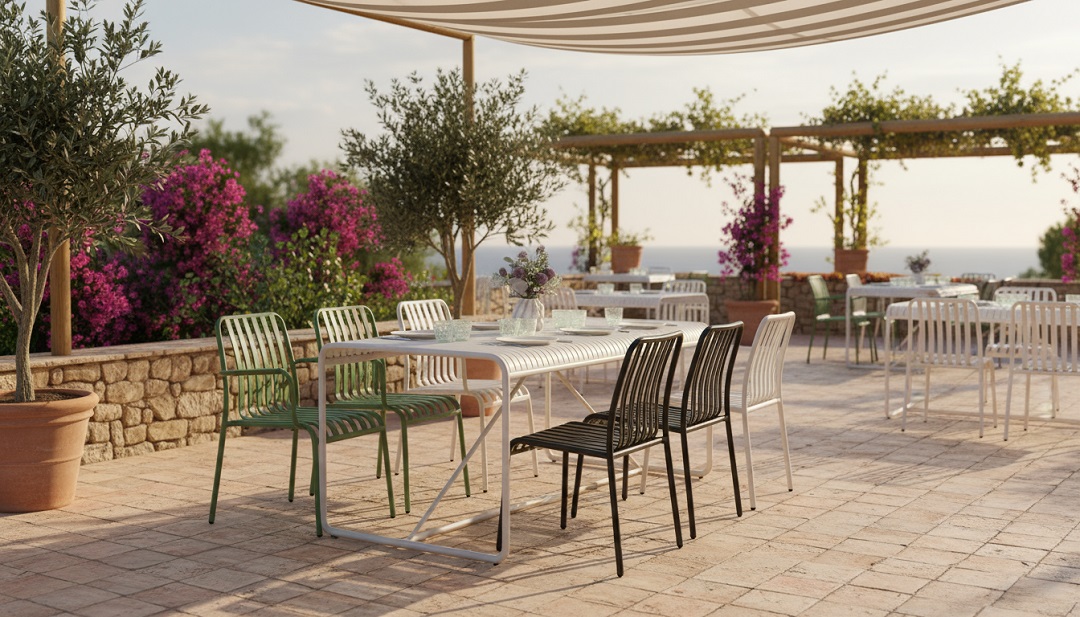
Most outdoor furniture orders that go wrong do not fail because the design was ugly. They fail because something was never measured. A seat height that sits 30 mm off the approved drawing, a carton that cannot stack, a chair frame that looks substantial in a catalogue photo but uses 1.0 mm aluminum tube — these gaps compound across hundreds of units and surface exactly when the selling season begins. For wholesale buyers sourcing aluminum outdoor furniture and commercial outdoor furniture, measurement is not a styling decision. It is a commercial control. Here are the five measurements that separate a smooth container order from a season of returns, warranty claims, and margin erosion.
1. Measure the Space — and the Clearance Around It
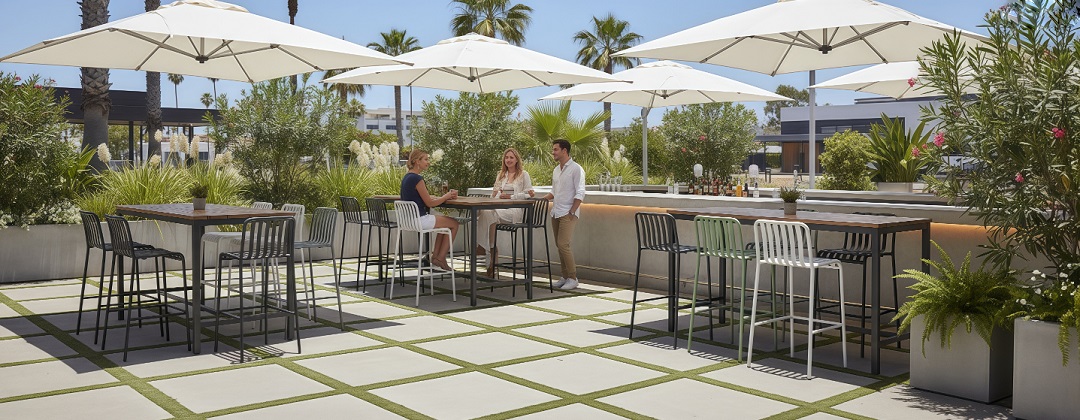
The first measurement is not the furniture. It is the floor plan. Raw square footage tells you very little, because furniture needs breathing room to function. A widely accepted baseline is 24–30 inches (61–76 cm) of walkway clearance around every grouping. For dining areas, allow approximately 100 cm from the table edge to the nearest wall so diners can pull out chairs without colliding with a boundary. In commercial settings — restaurant terraces, hotel pool decks, rooftop bars — increase that clearance to 36 inches (91 cm) to accommodate service staff, trolley access, and emergency egress.
Clearance Benchmark for Wholesale Buyers
The mistake wholesale buyers make is trusting the listed footprint of a dining set. A 160 cm × 90 cm table does not occupy 160 cm × 90 cm in use. Chairs pushed back typically add another 75–100 cm on each side. Before committing to a purchase order, request the product footprint from your supplier — an overhead outline showing the minimum floorspace required for the complete set in use — and mark it out on site with tape or chalk. For commercial outdoor furniture destined for hospitality venues, this single step prevents the most expensive error in the category: buying furniture that technically fits the patio but cannot serve the patio profitably.
2. Measure the Aluminum Wall Thickness — Not the Visual Bulk
Aluminum outdoor furniture can look identical in a photograph whether the frame uses 1.0 mm tube or 2.0 mm tube. That difference is invisible on a spec sheet summary, but it decides whether the furniture survives its first contract season. A residential dining chair often uses 1.0–1.2 mm aluminum tube — acceptable for a homeowner who moves the chair twice a season, but not for a hotel restaurant where the same chair is stacked, dragged, and sat on by hundreds of guests a week.
Thickness and Alloy Benchmark
For commercial outdoor furniture, the measurable floor is clear: visible structural components should start at 1.5 mm, and load-bearing parts such as chair frames, table bases, and lounger rails should move to 2.0 mm or above. Alloy selection matters alongside thickness: 6061-T6 or 6063-T5 tempers are the baseline for contract furniture, not generic recycled aluminum. Ask for the wall thickness and alloy grade in writing on every purchase order. A supplier who cannot state those two numbers in millimeters and alloy designations is selling a marketing word, not a specification. At CDG Furniture, our commercial-grade aluminum frames are engineered to these thresholds, because we know that for a wholesale buyer, “commercial grade” must be a verifiable number, not a label.
3. Measure the Seat Geometry Against the Body — Not the Catalogue Image
Seat height, seat depth, and table clearance are the measurements that determine whether furniture feels comfortable for ten minutes or ten hours. For outdoor dining chairs, a common contract range is 45–55 cm seat width, 40–48 cm seat depth, and a seat height of 43–50 cm from the ground. Those numbers are not arbitrary. A seat height below 43 cm can make the chair difficult for older guests and anyone with limited mobility to rise from. A seat depth beyond 48 cm without a lumbar cushion can leave shorter diners with their feet dangling. In commercial outdoor furniture, these details are not comfort extras — they are retention and liability factors.
Seat and Table Geometry Checks
Table measurements matter just as much. A standard four-person rectangular outdoor dining table typically runs 48–60 inches (122–152 cm) in length at 28–30 inches (71–76 cm) in height. For accessible commercial layouts, the tabletop height must fall between 28 and 34 inches, with at least 27 inches of vertical clearance beneath the table for wheelchair knee clearance. If your end client is a hotel, restaurant, or resort, measure these clearances against the accessibility standards that apply in their market before you confirm the order. A table that misses the height by two inches does not fail as furniture. It fails as a compliant commercial asset.
4. Measure Weight and Wind Exposure — Especially for Rooftops and Coastal Sites
Weight is a double measurement. Net weight per unit drives freight cost and handling, but the weight required at the base drives wind stability on exposed sites. Lightweight aluminum is an asset for daily repositioning and freight efficiency, but it becomes a liability on a rooftop bar or a beachfront terrace if the furniture is not specified with wind in mind. Commercial-grade tables and chairs on exposed sites may need to withstand wind loads of 60–80 mph (97–129 km/h), and weighted bases in the range of 50–70 lbs (23–32 kg) per table are a common starting point for stability.
Wind, Weight, and Finish Data
Before you specify a lightweight aluminum set for a rooftop or coastal project, ask three questions: Does the base accept floor mounting or ballast weights? What wind-load data can the manufacturer provide for the specific model? And does the finish carry salt-spray performance suitable for the site? For powder-coated aluminum in coastal and poolside commercial projects, neutral salt spray resistance exceeding 1,000 hours (ASTM B117) is the benchmark, alongside UV stability to Blue Wool 7+ or 500–1,000 hours of exposure with minimal color shift. Weight without weather data is only half the measurement.
5. Measure the Packed Volume — The Invisible Profit Line
The final measurement happens before the container is loaded, and it is the one most wholesale buyers leave too late. Outdoor furniture ships by volume, and two sofas with identical showroom footprints can differ by 30–40% in packed CBM depending on knock-down design, carton dimensions, and stacking logic. A 40HQ container has roughly 76 m³ of nominal internal volume, but realistic loadable volume for furniture is typically 65–68 m³ once carton shapes, stacking limits, and mixed-SKU loading are accounted for. If you calculate your landed cost from showroom dimensions, you will undercount freight and overcommit on units per container.
Packed Volume and Loading Plan
Ask your supplier for packed dimensions per unit — not just the assembled size — and a loading plan that shows how the cartons stack. Confirm whether mixed items are allowed in one container, and whether the packaging can survive the number of handling touches between factory and retail floor. For wholesale buyers, this measurement is not an operational footnote. It is the number that decides whether the order is profitable at the quoted price. CDG Furniture provides packed dimensions and container-loading data as part of the specification package, because a measurement you cannot see on the showroom floor is the one that protects your margin.
The Common Thread: Measure Before You Commit
These five measurements — space and clearance, aluminum wall thickness, seat geometry, weight and wind exposure, packed volume — share one principle. None of them can be corrected after the container ships. They must be confirmed in writing, on the purchase order, before production begins. That is the difference between buying outdoor furniture and specifying a commercial asset. If you are sourcing aluminum outdoor furniture or commercial outdoor furniture for hospitality, retail, or distribution, send us your space plan and volume requirements. We will help you translate those measurements into a specification that holds up at the factory, on the water, and on the terrace.