
A hotel terrace, a poolside restaurant, a rooftop bar — these are no longer secondary spaces. They are revenue centres, brand touchpoints, and the first thing a guest photographs. For garden furniture wholesalers, this shift has changed the brief. You are no longer supplying chairs and tables. You are supplying a commercial asset that must survive daily repositioning, coastal salt air, year-round UV exposure, and the operational reality that nobody on the hotel team has time to wax, oil, or baby the furniture.
That is the context in which commercial grade aluminum garden furniture has become the default specification for hospitality projects worldwide. But “commercial grade” is one of the most loosely used phrases in the industry. This article breaks down what it actually means in verifiable numbers, so wholesale buyers can specify with confidence, protect margin, and reduce the warranty claims that quietly erode profitability.
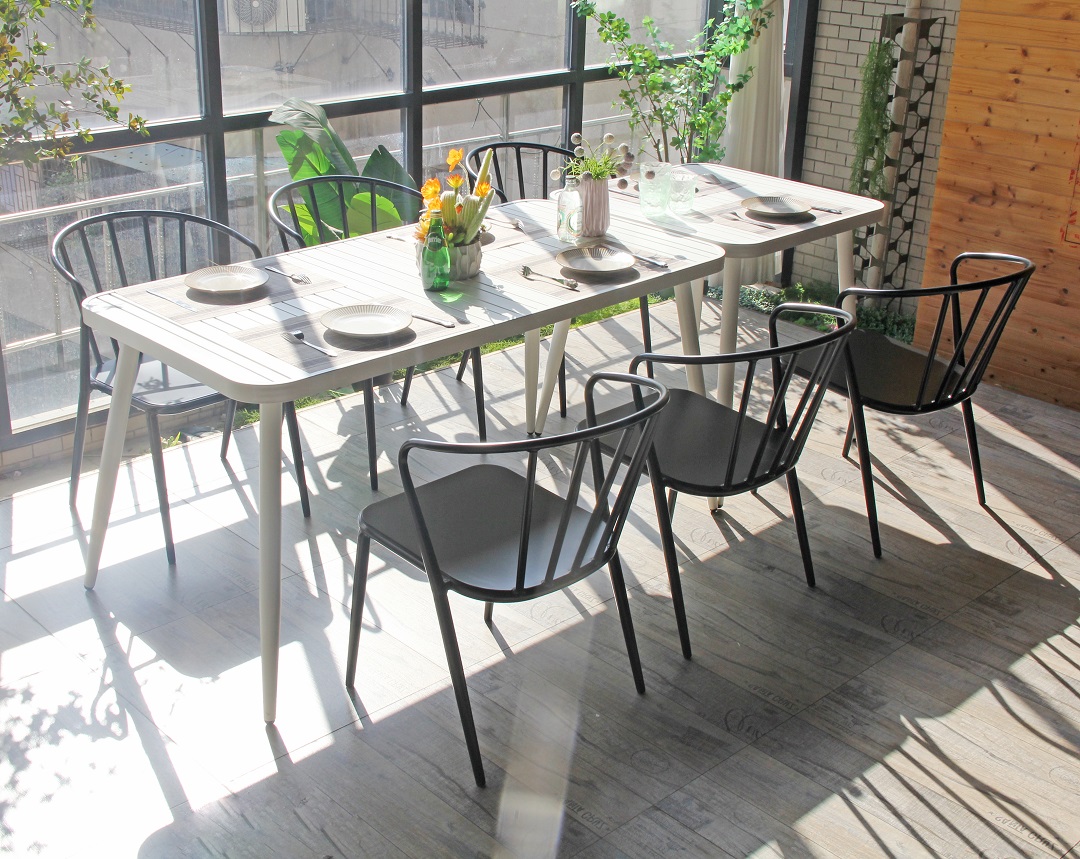
What “Commercial Grade” Actually Means in Aluminum Garden Furniture
The difference between residential aluminum garden furniture and true commercial grade is not a label. It is wall thickness, alloy grade, coating performance, and test evidence.
A residential dining chair often uses 1.0–1.2 mm aluminum tube. That is acceptable for a homeowner who moves the chair twice a season. It is not acceptable for a hotel restaurant where the same chair is stacked, dragged, and sat on by hundreds of guests a week. Commercial-grade aluminum frames should start at 1.5 mm for visible structural components and move to 2.0 mm or above for load-bearing parts such as chair frames, table bases, and lounger rails. Alloy selection matters too: 6061-T6 or 6063-T5 tempers are the baseline for contract furniture, not generic recycled aluminum.
The testing standards are equally specific. Contract seating for European hospitality should reference EN 581-1/-2, which requires outdoor seating to withstand 100,000+ seat fatigue impact cycles without structural failure. In North America, ANSI/BIFMA X5.4 and ASTM F1858 are the relevant contract-grade references. For coating performance, commercial-grade powder-coated aluminum should exceed 1,000 hours of neutral salt spray (ASTM B117) for coastal and poolside projects, and achieve Blue Wool 7+ or 500–1,000 hours of UV exposure (ASTM G154) with ΔE ≤ 2 for colour stability.
If a supplier cannot put those numbers on paper, “commercial grade” is a marketing word, not a specification.
Why Aluminum Remains the Default Frame for Hotel and Restaurant Terraces
Aluminum is not the cheapest frame material per kilogram, but it is the most practical for hospitality when specified correctly. It does not rust, it keeps freight costs manageable because it is lightweight, and it accepts powder-coat finishes that can match brand palettes in matte, textured, or wood-grain effects.
Compared with powder-coated steel, aluminum eliminates the weld-point rust risk that appears within the first season in humid or coastal climates. Compared with solid teak, it requires no seasonal oiling and does not crack under thermal cycling. Compared with PE rattan on a steel frame, a full-aluminum construction removes the dissimilar-metal corrosion that shortens service life in pool environments.
The trade-off is that aluminum is only as good as its wall thickness and coating. A beautifully finished 1.0 mm aluminum chair will still flex, fatigue, and fail in a contract setting. Wholesale buyers should treat wall thickness and salt-spray rating as the two non-negotiable gates in supplier qualification.
The Specification Checklist for Every Hospitality Purchase Order
For wholesalers sourcing aluminum garden furniture for hotels and restaurants, the purchase order should read like an engineering document, not a catalogue description. The following checkpoints separate a five-year asset from a one-season liability:
Frame Construction
Specify 6063-T5 or 6061-T6 alloy. Require minimum 1.5 mm wall thickness on visible tube and 2.0 mm on structural components. Welds should be full-penetration, ground smooth, and fully covered by coating — no exposed seam where moisture can wick into the tube.
Powder Coating
Minimum 60–80 μm film build. For coastal or poolside projects, demand ≥1,000 hours neutral salt spray. For high-UV markets such as the Middle East, Australia, and Southeast Asia, require Blue Wool 7+ or equivalent xenon-arc UV data, not a generic “UV resistant” claim.
Fabric and Cushioning
Solution-dyed acrylic or equivalent performance fabric should be rated to 2,000+ hours UV exposure (ISO 105-B02); generic coated polyester degrades visibly within 500–800 hours. Quick-dry reticulated foam and antimicrobial treatments are operational necessities for restaurants and resorts where cushions stay outdoors.
Hardware and Interfaces
Stainless steel or zinc-plated fasteners, plastic glides that do not stain decking, and stacking bumpers that protect powder coating during daily handling.
Certification and Traceability
EN 581 test reports, BIFMA X5.4 documentation, ISO 9001 factory certification, and material traceability for the aluminum billet. A supplier who can provide these is a supplier who understands contract furniture.
Design and Operational Demands Unique to Hotels and Restaurants
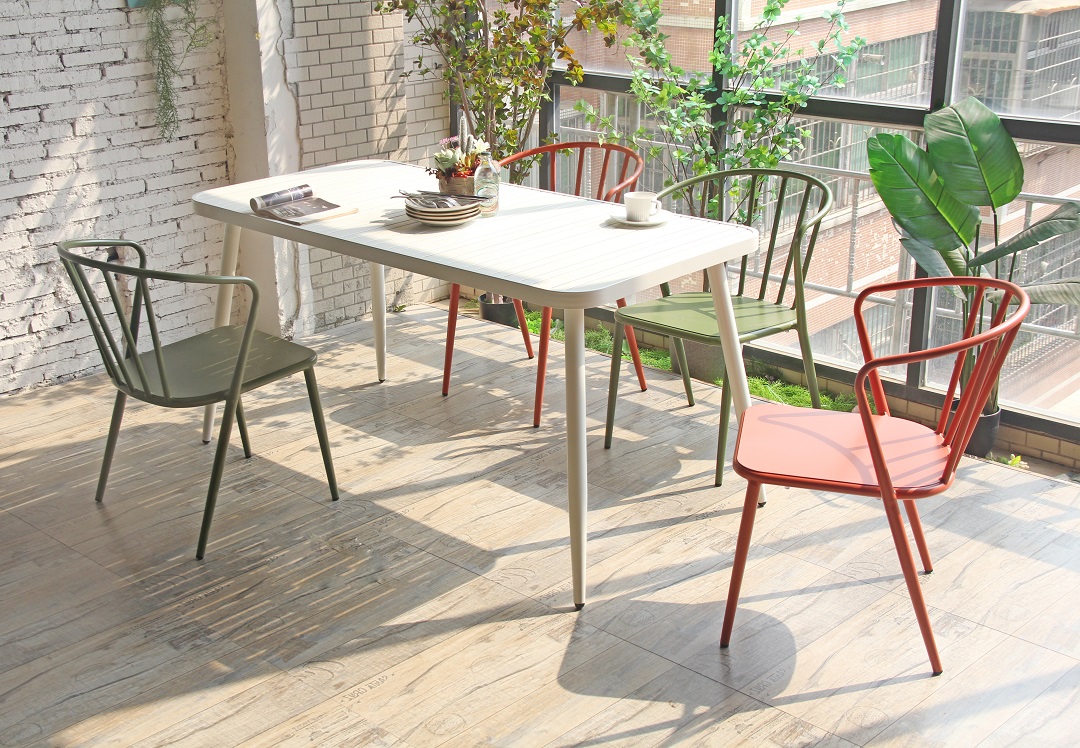
Hospitality buyers evaluate furniture through an operational lens. A restaurant manager wants chairs that stack 28–40 pieces per stack and can be moved by one staff member. A resort housekeeping team wants slings and cushions that can be power-washed or replaced without retiring the whole frame. A procurement director wants the same finish colour across three properties, three years apart.
This is where full-aluminum commercial furniture outperforms mixed-material alternatives. All-aluminum dining chairs and stacking chairs are light enough for one-person handling but stiff enough to avoid the “wobbly chair” complaint that plagues thinner residential frames. Replacement slings, modular cushion covers, and stackable/nestable designs extend the service life of the frame and reduce total cost of ownership.
The design language of hospitality outdoor furniture has also shifted. The indoor-outdoor seamless trend documented at CIFF 2026 is not a residential fad; it is a commercial strategy. Hotels and restaurants are reconfiguring terraces as flexible revenue zones, using modular upholstered seating that looks at home in a lounge but is engineered for rain, UV, and thermal expansion. For wholesalers, this means the aluminum frame is increasingly hidden beneath performance textiles and quick-dry foam — but the frame specification becomes more important, not less, because the furniture is being used harder and expected to look softer.
The Wholesale Business Case: Specification Protects Margin
A low-spec aluminum chair is cheaper per unit and more expensive per year. The hidden costs arrive as warranty claims, return freight, labour for replacing failed pieces, and the reputational damage of a hotel client who cannot open a terrace because half the chairs are loose.
A commercial-grade specification changes the commercial equation. It reduces after-sales workload, supports a premium price position, and allows wholesalers to sell into coastal, tropical, and cold-climate markets without regional restrictions. It also improves container economics. Knock-down and stackable engineering at the better factories now compresses outer carton volume by 40–55% compared with traditional fully assembled packaging, directly reducing landed cost per unit.
MOQ logic in aluminum hospitality ranges typically starts at 100–300 sets per SKU for aluminum dining and stacking collections, with mixed-container loading available for buyers who need to spread risk across multiple models. The wholesalers who win hospitality accounts are the ones who treat MOQ as a container-planning exercise, not a barrier.
Sourcing From a Manufacturer Built Around Commercial Aluminum
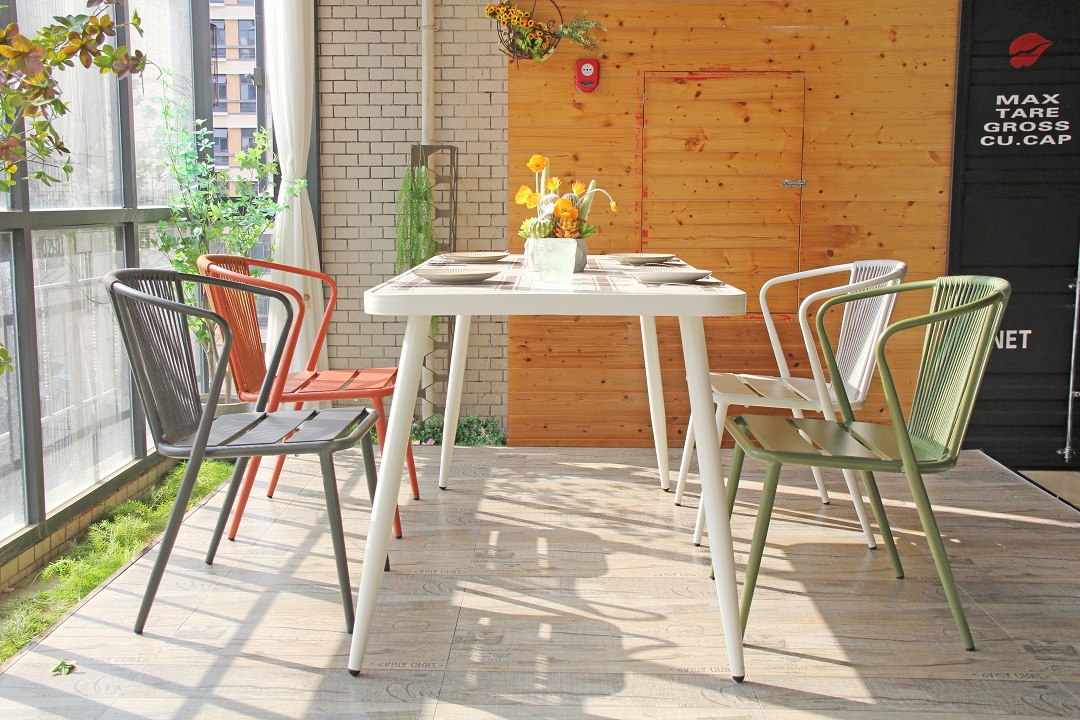
This is the context in which CDG Furniture Group operates. With more than 20 years in commercial and outdoor furniture, a 20,000+ m² production facility, and a 150-person semi-automated line, CDG manufactures fully powder-coated aluminum dining chairs, stacking chairs, tabletops, and complete outdoor dining sets for bulk wholesale supply. The company’s commercial portfolio includes collaborations with foodservice and hospitality brands such as KFC, Starbucks, Hilton Group, and InterContinental Group, and it launches 500+ new designs annually across outdoor, garden, and dining categories.
For wholesale buyers evaluating any commercial aluminum supplier — CDG included — the right next step is not to request a catalogue. It is to request the specification file: alloy and wall-thickness data, powder-coat salt-spray and UV reports, EN 581 or BIFMA test summaries, stacking and container-loading plans, and a sample from the actual production run. A manufacturer who can answer those questions in writing is a manufacturer equipped for hospitality. A manufacturer who cannot is selling residential furniture with a commercial label.
The hospitality terrace is a commercial asset. Specify it like one, and the repeat orders follow.
Ready to review commercial-grade aluminum garden furniture specifications for your hotel or restaurant project?
Contact CDG Furniture Group to request test reports, sample availability, and a container-loading proposal tailored to your market.